
Dual Vocational Training in Spain: a business perspective
Together with IESE Business School and Empieza por Educar, we have presented a new report capturing the views of 21 companies on the challenges and opportunities of Dual Vocational Education and Training (Dual VET) in Spain, while highlighting the need to raise the visibility of students enrolled in Basic Vocational Education and Training (Basic VET).
Key findings from the report on Dual Vocational Education and Training in Spain: a business perspective
Spain continues to have the highest youth unemployment rate in the European Union, while thousands of companies struggle to recruit qualified technical professionals. To help bridge this gap between education and employment, on 23 June we presented the report Vocational Education and Training in Spain: A Business Perspective at IESE Business School in Madrid. The research was conducted in collaboration with the Chair of Business Leadership and the Future of Work – Fundación Joaquim Molins Figueras at IESE Business School and Empieza por Educar. The study brings together the perspectives of 21 companies across 15 industries on the main barriers and opportunities for strengthening Dual VET in Spain.
The report starts from a reality that cannot be overlooked: Vocational Education and Training is a strategic tool for improving young people’s employability, facilitating the integration of qualified talent into the workforce, and responding to the needs of the productive economy. However, companies continue to face administrative, organisational, and cultural barriers that hinder the wider implementation of this model. Among the report’s key recommendations are strengthening collaboration between companies and educational institutions, updating training curricula, simplifying administrative procedures, and introducing incentives to encourage greater business participation, particularly among small and medium-sized enterprises (SMEs).
The event brought together representatives from the education, business, and social sectors in a space for reflection on the present and future of Dual VET. Following the presentation of the report’s main findings, a panel discussion entitled “Opportunities and Challenges of Dual VET” was moderated by Mireia Las Heras, Director of the Chair of Business Leadership and the Future of Work – Fundación Joaquim Molins Figueras at IESE Business School. The panel featured Virginia Luca de Tena, Director of Fundación Mahou San Miguel; Beatriz Ramos, Corporate Training and Recruiting Manager at Molins; Mónica Gutiérrez, General Director of Corporate Services at ViServeis; and Tomás Alonso, Director of Instituto Tomás y Valiente. During the discussion, the speakers shared their experiences and agreed on the importance of strengthening collaboration between companies, educational institutions, and social organisations to expand Dual VET and better align it with labour market needs.
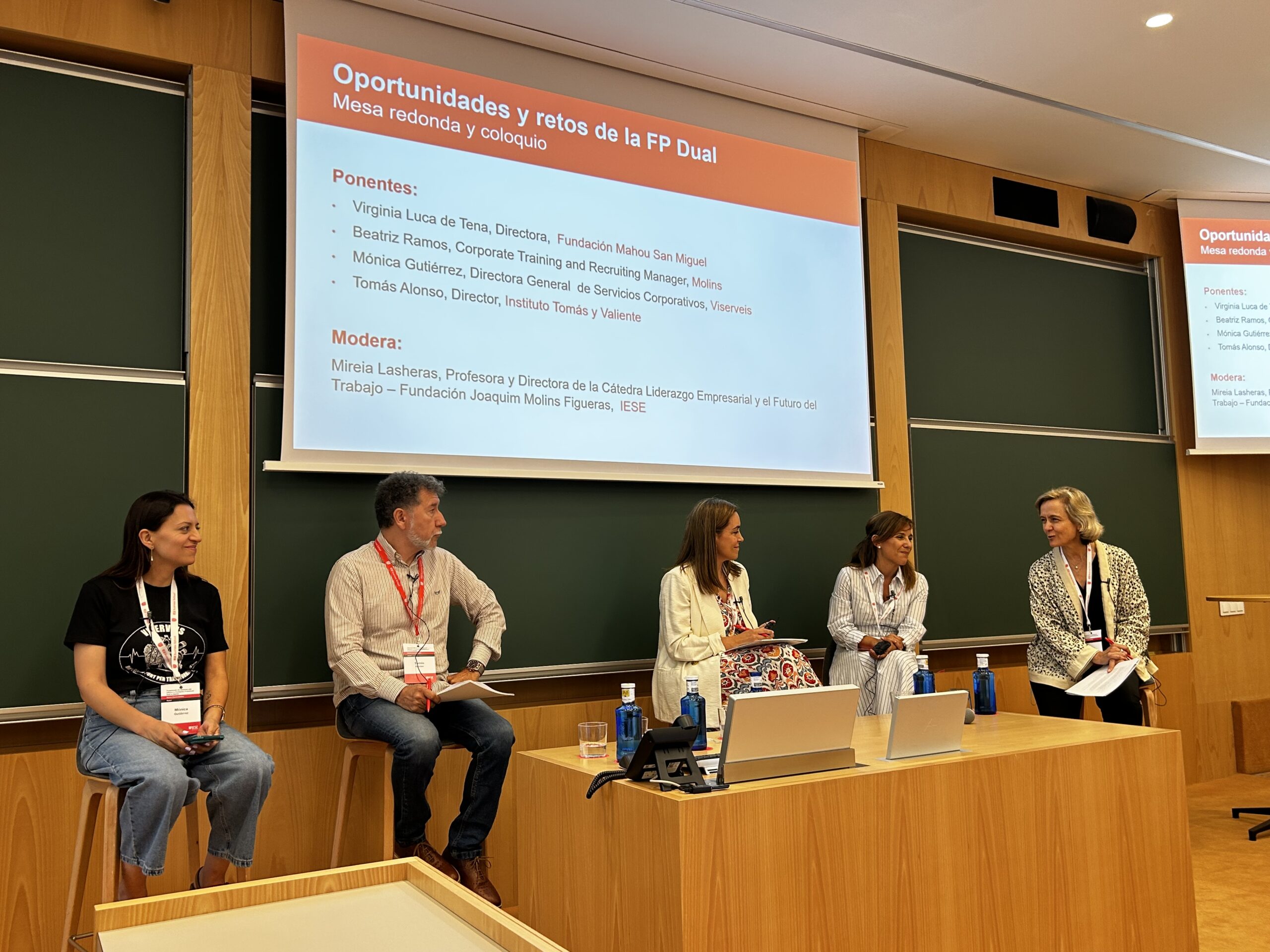
Panel discussion with Mireia Las Heras, Virginia Luca de Tena, Beatriz Ramos, Mónica Gutiérrez and Tomás Alonso
One of the central messages of the event was the need to increase the visibility of Basic VET, which the report identifies as the educational pathway facing the greatest challenges in engaging employers, despite its enormous potential to promote the social and labour market inclusion of young people in vulnerable situations.
In this context, Nacho Sequeira, CEO of Fundación Exit, stressed that “the challenge we face today is giving greater visibility to Basic VET students.” He also highlighted the transformative impact that early exposure to the workplace can have on these young people: “The further a young person is from the labour market, the more powerful their work placement experience becomes.” His remarks reflect our commitment to a Vocational Education and Training system that creates real opportunities for those who need them most.
For more than 25 years, Fundación Exit has been working to reduce early school leaving and improve the future prospects of young people facing social vulnerability. Through this report, we aim to generate knowledge, foster dialogue among all stakeholders, and contribute to the development of a Dual VET model that more effectively connects the worlds of education and business.
The report concludes that building a stronger Dual VET system requires the joint commitment of companies, educational institutions, public administrations, and social organisations. At Fundación Exit, we will continue to promote partnerships that bring businesses closer to young people, ensuring that their future opportunities are determined not by their background or postcode, but by their talent and the opportunities they are given to develop.

