
The philanthropic sector explores new ways to address social challenges at Demos 2026
How can we respond to increasingly complex social problems? And what role should foundations play in addressing new forms of vulnerability? These were some of the questions at the heart of Demos 2026, the 10th Forum of Foundations and Civil Society, held in Barcelona on 30 September and 1 October.
Under the theme “Vulnerabilities and Philanthropy: Foundations as a Response”, the event brought together foundations, professionals, experts and representatives from different fields to share experiences, build partnerships and reflect on some of today’s key social challenges. Organised by the Spanish Association of Foundations (AEF) and the Coordinadora Catalana de Fundacions (CCF), Demos came to Barcelona for the first time, coinciding with its tenth edition.
Over two days, the programme addressed issues such as social action, education, childhood, climate action and impact, combining plenary sessions, workshops, visits and opportunities for exchange. The aim was not only to share knowledge but also to foster new connections and collaborations across the sector.
When vulnerabilities overlap
One of the ideas that came up repeatedly during the forum was that situations of vulnerability can no longer be understood in isolation. A person may face several challenges simultaneously, relating to access to housing, employment, mental health, care, education or their financial situation. These circumstances do not simply accumulate; they often reinforce one another.
For this reason, speaking in terms of “groups” can be insufficient to describe realities that are increasingly diverse and complex. Vulnerability has neither a single cause nor a single solution.
The conclusion is clear: before taking action, we need to gain a better understanding of what is happening and how the different dimensions of a given situation are interconnected.
Fundación Exit joins the conversation on social action
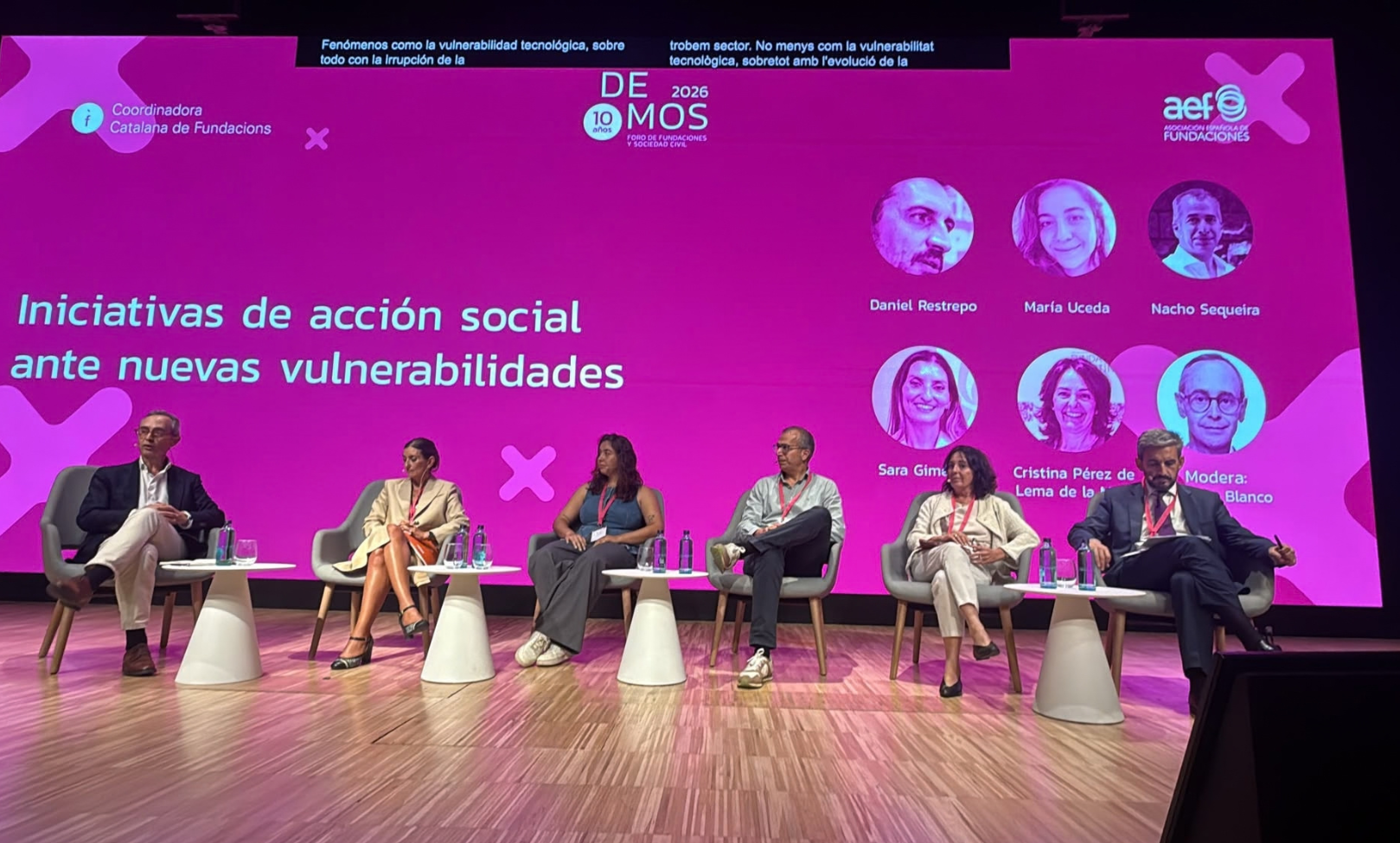
In this context, a roundtable on social action took place, featuring Nacho Sequeira, Managing Director of Fundación Exit, alongside representatives from Fundación Mapfre, Fundación Secretariado Gitano, Fundación Botín and Fundación Almería Tierra Abierta.
The discussion raised a particularly relevant question: how can we move from individual initiatives towards responses capable of bringing about broader change?
Daniel Restrepo Manrique, Director of Social Action at Fundación Mapfre, highlighted the importance of advancing towards comprehensive inclusion, while Sara Giménez, Director of Fundación Secretariado Gitano, emphasised employment as a driver of integration and social transformation.
Cristina Pérez de Lema, from Fundación Botín, underlined the need for collaboration among different stakeholders. This idea was also echoed by María Uceda López, from Fundación Almería Tierra Abierta, who brought a territorial perspective to the discussion.
For Nacho Sequeira, all these contributions point towards one common concept: collective impact.
From networking to collective impact
Working in networks is important, but it is not always enough. When faced with complex social problems, the challenge is not simply for different organisations to collaborate or share resources. It is about coordinating capabilities, knowledge and responsibilities to address a situation collectively, one that no organisation can resolve on its own.
An example helps illustrate this: if a young person we support to improve their education also faces difficulties accessing housing, our response does not necessarily need to involve becoming an organisation specialising in housing. We can and should identify this need and coordinate with those who have the knowledge and tools to address it.
This approach to collaboration allows each organisation to contribute what it does best while ensuring that responses are connected.
Collective impact means moving from asking what each organisation can do individually to asking what we can achieve when we bring our capabilities together in pursuit of a shared goal.
A challenge for the entire sector
This reflection becomes even more important in a context marked by uncertainty, polarisation and social problems that evolve faster than many of our responses.
Demos also highlighted the role of foundations as institutions capable of connecting civil society and taking a long-term perspective. Unlike other stakeholders, foundations can promote projects that are not tied to an electoral cycle or a specific campaign, and build lasting partnerships around shared challenges.
For Fundación Exit, this perspective is directly connected to the way we work: bringing education, businesses and society together to create more opportunities for young people.
Career guidance, training, contact with professionals, a first experience in a company and decisions about which path to follow cannot be viewed as independent elements. Young people’s opportunities are shaped by multiple factors and, therefore, effective responses also require connecting those who can contribute to them.
From reflection to action
Demos 2026 leaves us with a particularly relevant message: doing more is not enough. We need to understand better, coordinate more effectively and ask ourselves what impact we want to achieve together.
The challenge for the philanthropic sector is not only to identify emerging needs but also to find new ways of responding to them. This means embracing collaboration with other stakeholders: the people directly affected by social challenges, social organisations, businesses, academia, public administrations and other civil society actors.
In a context where vulnerabilities overlap and responses need to become increasingly interconnected, the ability to collaborate can be just as important as the ability to act. This is one of the key lessons we take away from Demos 2026: we must continue to combine reflection and action, while also learning how to bring them together.
Because when challenges are complex, impact cannot be achieved alone.

