
Dual VET: connecting education with the world of work to boost youth employment
Combining classroom learning with practical experience in companies creates new opportunities for young people and strengthens the link between education and employment.
Youth unemployment remains one of Spain’s major social and economic challenges. Although the situation has improved in recent years, difficulties in accessing the labour market continue to affect young people, particularly those with lower levels of education or fewer opportunities to engage with the professional world.
According to Spain’s Labour Force Survey (EPA), conducted by the National Statistics Institute (INE), and analysis reports from the Ministry of Labour and Social Economy, the unemployment rate among young people under 25 stood at 23.33% in the third quarter of 2026. Although this represents a decrease of 2.09 percentage points compared with the same period in 2025, the figure highlights the continued need to promote initiatives that facilitate the transition from education to employment.

In this context, Dual Vocational Education and Training (Dual VET) offers a way to improve youth employability, bring education and training closer to the real needs of companies, and provide young people with their first experience in a working environment.
But what does this model involve, and what role can it play in reducing youth unemployment?
What is Dual VET and how does it work?
Dual Vocational Education and Training is an educational model that combines learning at a training centre with a period of practical training in a company. This allows students to apply the knowledge they have acquired, develop professional skills and gain first-hand experience of how the world of work operates.
With the new Vocational Education and Training Law, Spain has moved towards a system in which all VET programmes include training in a company. The model provides for two pathways, general and intensive, which differ, among other aspects, in the amount of time spent training in the workplace and the nature of company involvement.
This approach represents a shift in the relationship between education and employment: companies are no longer simply a destination after students complete their studies, but also become active participants in the training process.
In addition to acquiring technical knowledge, young people have the opportunity to develop transferable skills such as communication, independence, responsibility, teamwork and adaptability, all of which are essential for their professional future.
Dual VET and youth employment: what does the data tell us?
One of the main arguments in favour of Dual VET is its potential to help young people enter the labour market.
According to data published in 2025 by Spain’s Ministry of Education, Vocational Training and Sports, 40.1% of students who graduated from intermediate-level Dual VET programmes in the 2020-2021 academic year were registered with the Social Security system during the first year after graduation, compared with 36.1% of those who completed non-dual programmes.
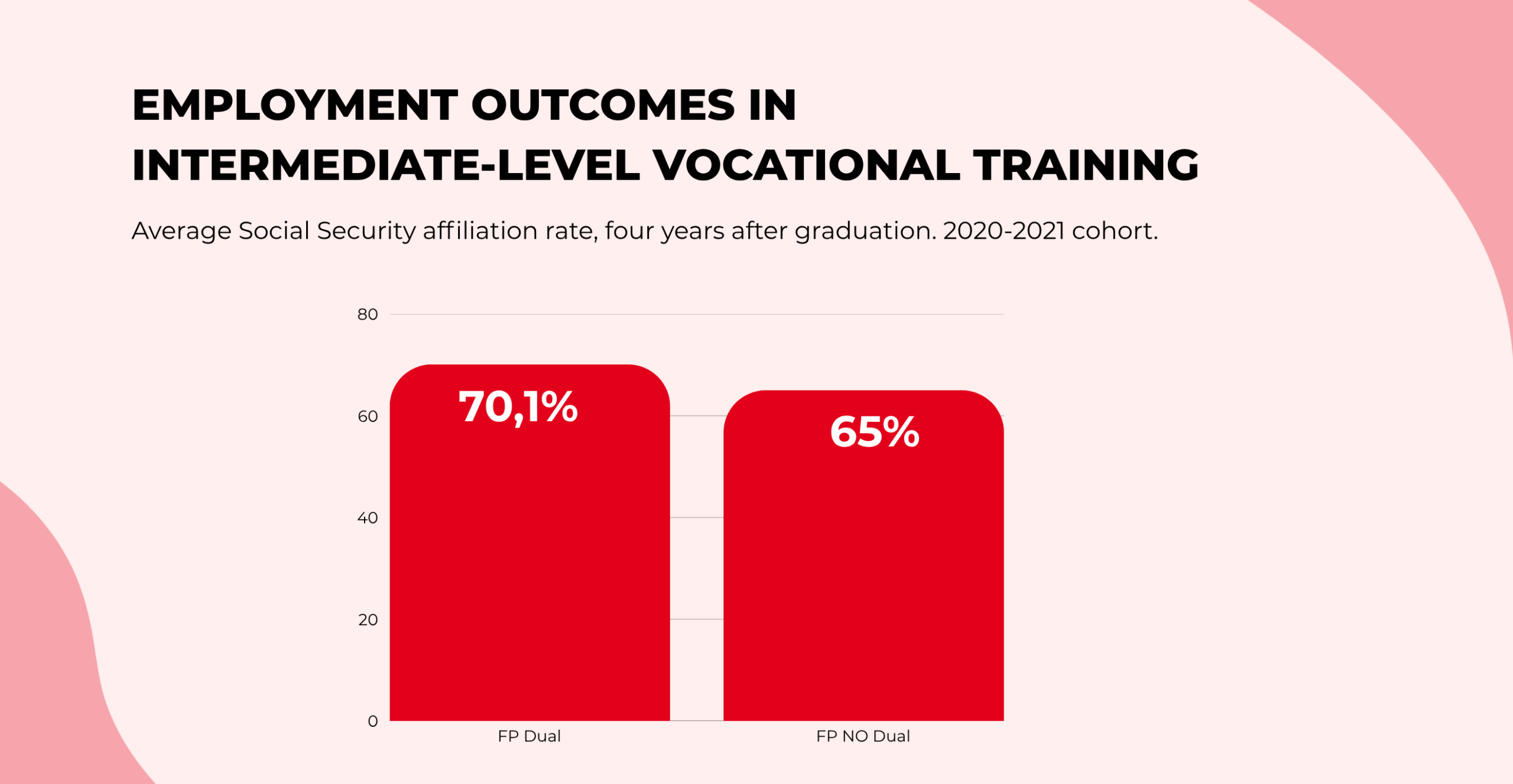
This difference persists over time: four years after completing their studies, the Social Security registration rate reached 70.1% among Dual VET graduates, compared with 65% among graduates of non-dual programmes.
These results show a positive association between dual training and labour market integration, although employment outcomes also depend on other factors, such as the professional sector, geographical location and student characteristics.
Dual VET is therefore not a standalone solution to youth unemployment, but it is a tool that can help facilitate the transition from education to employment, particularly when combined with appropriate career guidance and close collaboration between educational institutions and companies.
 Source: Official VET Graduate Labour Market Integration Statistics 2025
The employment outcomes of VET graduates also vary by geographical location. According to the same Ministry of Education report, Catalonia recorded an average Social Security registration rate of 63.5% in the third year after graduation, followed by other regions such as the Region of Murcia (62.5%) and the Community of Madrid (61.8%). By contrast, the Valencian Community (56.4%) and Andalusia (54.2%) were below the national average (59%). These differences highlight the importance of connecting education and training with employment opportunities and the needs of the local business community in each region.
Employment opportunities also vary depending on the vocational field. Among graduates of intermediate-level VET programmes in the 2020–2021 academic year, Healthcare (46.7%), Transport and Vehicle Maintenance (46.3%) and Mechanical Manufacturing (45%) recorded the highest Social Security registration rates during the first year. Three years later, Transport and Vehicle Maintenance (70.6%), Mechanical Manufacturing (70.1%) and Installation and Maintenance (68.9%) stood out in particular.
These figures reinforce the importance of providing career guidance that takes into account both young people’s interests and abilities and the opportunities available in the labour market.
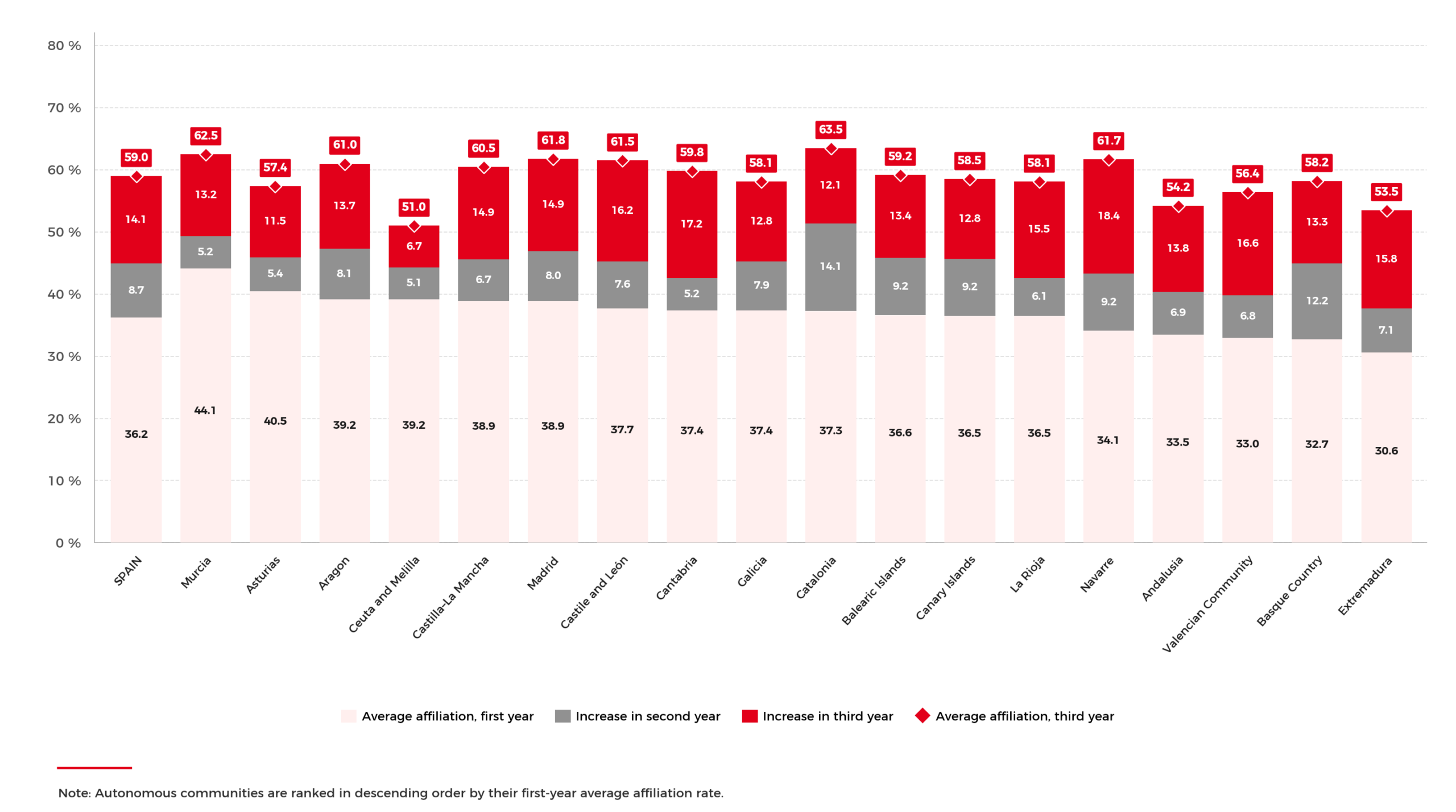
Average Social Security registration rate by autonomous community and period. 2020-2021 cohort. Intermediate-level VET programmes.
The role of companies: connecting talent and opportunities
One of the defining features of Dual VET is the involvement of the business community.
Companies not only provide opportunities for practical learning but can also help identify the skills required by the labour market and introduce young people to professions and sectors they may not previously have considered.
This collaboration is particularly relevant in a context where two realities coexist: young people who struggle to access their first job and companies that need to recruit qualified technical professionals.
However, several barriers must be overcome for this model to reach its full potential.
In June 2026, Fundación Exit, together with IESE Business School and Empieza por Educar, presented the study La Formación Profesional en España: una mirada desde las empresas (Vocational Education and Training in Spain: A Business Perspective), which gathered insights from 21 companies across 15 sectors on the main challenges and opportunities of Dual VET.
Among its findings, the study highlights the need to strengthen collaboration between companies and educational institutions, simplify administrative procedures, align training content with labour market needs, and encourage the participation of small and medium-sized enterprises.
The study also focuses on Basic VET, a pathway that faces greater challenges in engaging the business community, despite its potential to promote the social and labour market inclusion of vulnerable young people.
Promoting Dual VET therefore means more than simply increasing training opportunities within companies. It also means ensuring that these opportunities are accessible to all young people.
Career guidance and support: keys to inclusive Dual VET
Engaging with the world of work can be a transformative experience for young people, especially those who are still unsure about what they want to study or which career path they would like to pursue.
Exploring different professions, discovering their own abilities and having professional role models can help them make more informed decisions about their future.
However, not all young people start from the same position. A lack of career guidance, socioeconomic difficulties or limited connections with the business community can restrict their access to certain educational and training opportunities.
At Fundación Exit, we work to reduce early school leaving and improve the employability of socially vulnerable young people by connecting the worlds of education and business.
Through our School-Business Training programme (Formación Escuela-Empresa), we promote experiences that combine classroom learning with practical training in companies, incorporating career guidance, skills development and personalised support.
During the 2024-2025 academic year, a total of 351 young people participated in Fundación Exit’s School–Business programme, with the involvement of 270 companies and 10 educational organisations. According to the results published in our 2024-2025 Annual Report, 86% of first-year School–Business participants who responded to the survey continued their studies after completing the project. Meanwhile, among surveyed second-year School-Business participants, 54% gained work experience and, of these, 92% did so in the sector for which they had trained.
These results highlight the value of connecting education and training with real experiences in companies, both to encourage young people to continue their education and to help them engage with the labour market.
For this reason, career guidance and personalised support are essential if Dual VET is also to contribute to reducing inequalities.
An opportunity to bridge the gap between education and employment
The future of Dual Vocational Education and Training will depend on the ability of different stakeholders to work together effectively.
Educational institutions, companies, public authorities and social organisations all play a fundamental role in ensuring high-quality training that responds to labour market needs and is accessible to young people with different backgrounds and experiences.
In this respect, the challenge is not simply to increase the number of training places or levels of company participation, but also to ensure that training experiences contribute to learning, continued engagement in education and students’ professional development.
Dual VET offers an opportunity to move towards an educational model that is more closely connected to the world of work, capable of responding to the needs of businesses without losing sight of those of young people.
Because improving youth employability is not just about helping young people access their first job. It is also about providing the tools, confidence and opportunities they need to build their professional future.
And achieving this requires stronger collaboration than ever between education, business and the third sector.
Would you like to discover more initiatives connecting young talent with new opportunities? Subscribe to our newsletter and explore Fundación Exit’s projects, stories and insights on education, career guidance and youth employment.

