
Youth and employment: expectations and perceptions of the future of work in Spain
For years, one idea has been repeated: that younger generations do not want to work, that they seek immediacy, or that they have unrealistic expectations.
However, the data tells a different story. A recent Mazzin report on youth and employment and young people’s work expectations, based on a sample of more than 700 young people in Spain, paints a more complex picture: a generation that looks to the future with a mix of optimism and concern, aware that the labour market they are entering is more uncertain than that of previous generations.
Rather than a generation disconnected from work, we are talking about a generation that is redefining its expectations in a structurally more fragile context.
A starting point that shapes the context
The study focuses on young people between 18 and 29 years old. Within the sample, 40% are between 18 and 21, another 40% between 22 and 24, and the remaining 20% between 25 and 29. In terms of gender, 59% are women, 39.9% men, and 1% do not specify.
This diversity helps to understand different stages of transition into employment and the construction of professional careers.
At the same time, the labour context has changed significantly over the last two decades. The presence of young people in the labour market has fallen from 25.3% in 2005 to 15.3% in 2025.
In addition, according to the Spanish Ministry of Labour and Social Economy, in its Quarterly Report on Youth and the Labour Market, the youth unemployment rate (15–24 years old) in Spain stands at around 26.5%, compared to an EU average of around 15%. In other words, Spain continues to have one of the highest youth unemployment rates in the European Union.
To this we must add other structural factors:
A més, segons el Ministeri de Treball i Economia Social, en el seu Informe trimestral de joves i mercat de treball, la taxa d’atur juvenil (15-24 anys) a Espanya se situa al voltant del 26,5%, davant d’una mitjana de la Unió Europea propera al 15%. És a dir, Espanya manté una de les taxes d’atur juvenil més elevades de la Unió Europea.
A això s’hi afegeixen altres factors estructurals:
- Lower wages compared to previous generations
- Greater job precariousness and instability
- Increasingly delayed emancipation
- High levels of overqualification
- Early school leaving rate of 12.8% in 2025 (vs. 9.4% EU average)
The result is clear: access to employment is not only more difficult, but also more unequal. And this inequality is especially intensified among young people in situations of social vulnerability, who often have fewer support networks, more fragmented educational pathways, and greater difficulties in accessing their first work experience.
Between access and uncertainty: how young people perceive their future
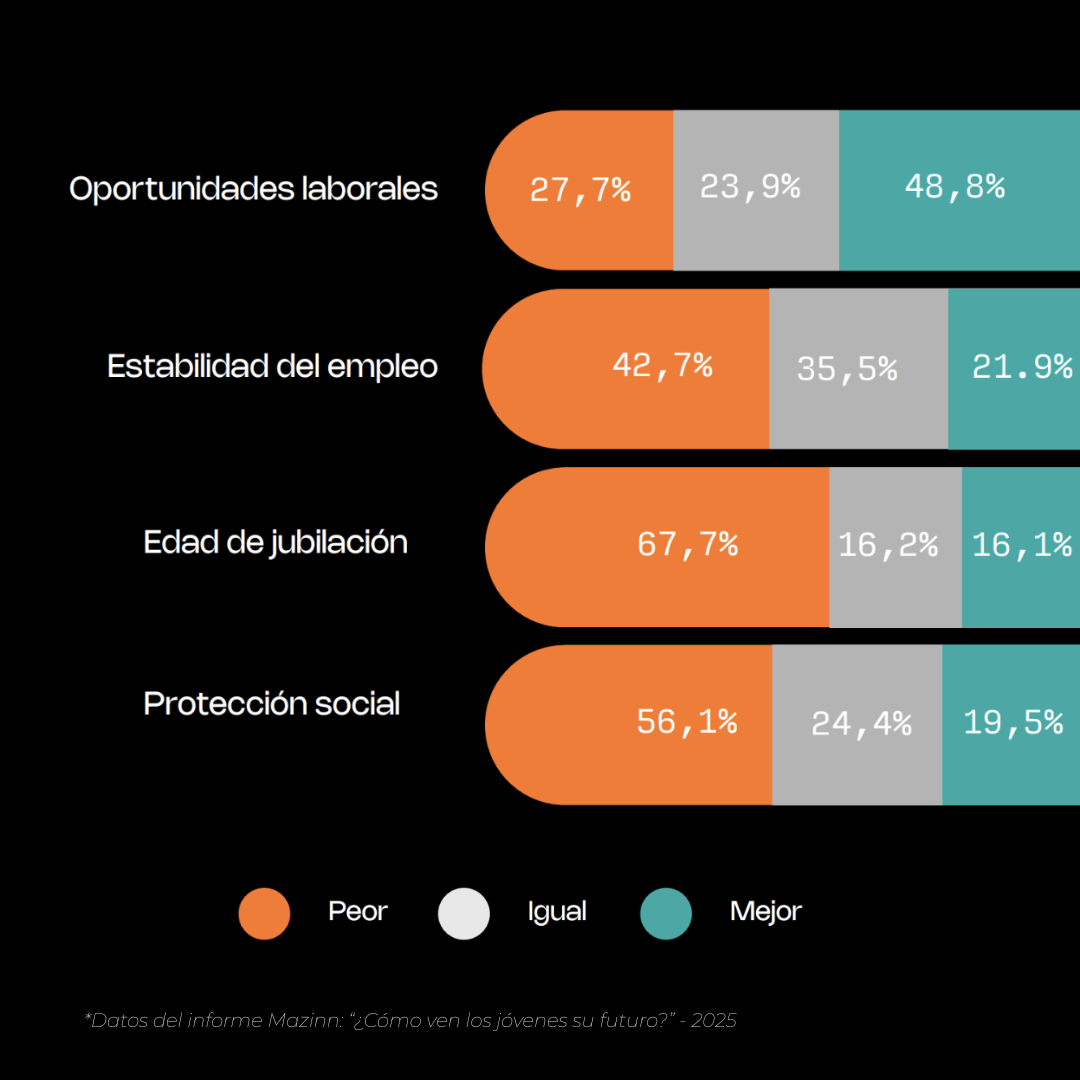
When young people are asked about their future, the answer is ambiguous. Almost half (48.8%)* believe they will have more job opportunities than the previous generation. However:
- 42.7% expect less job stability
- 67.7% anticipate worse pension conditions
- More than half expect less social protection
In other words, access is perceived, but not the construction of a stable life project. This difference is key, especially for young people who already start with fewer resources or support.
*Data from Mazzin report: “What do young people see in their future?” – 2025
What do young people expect from work?
In this context, work expectations are not random, but consistent with the reality they perceive.
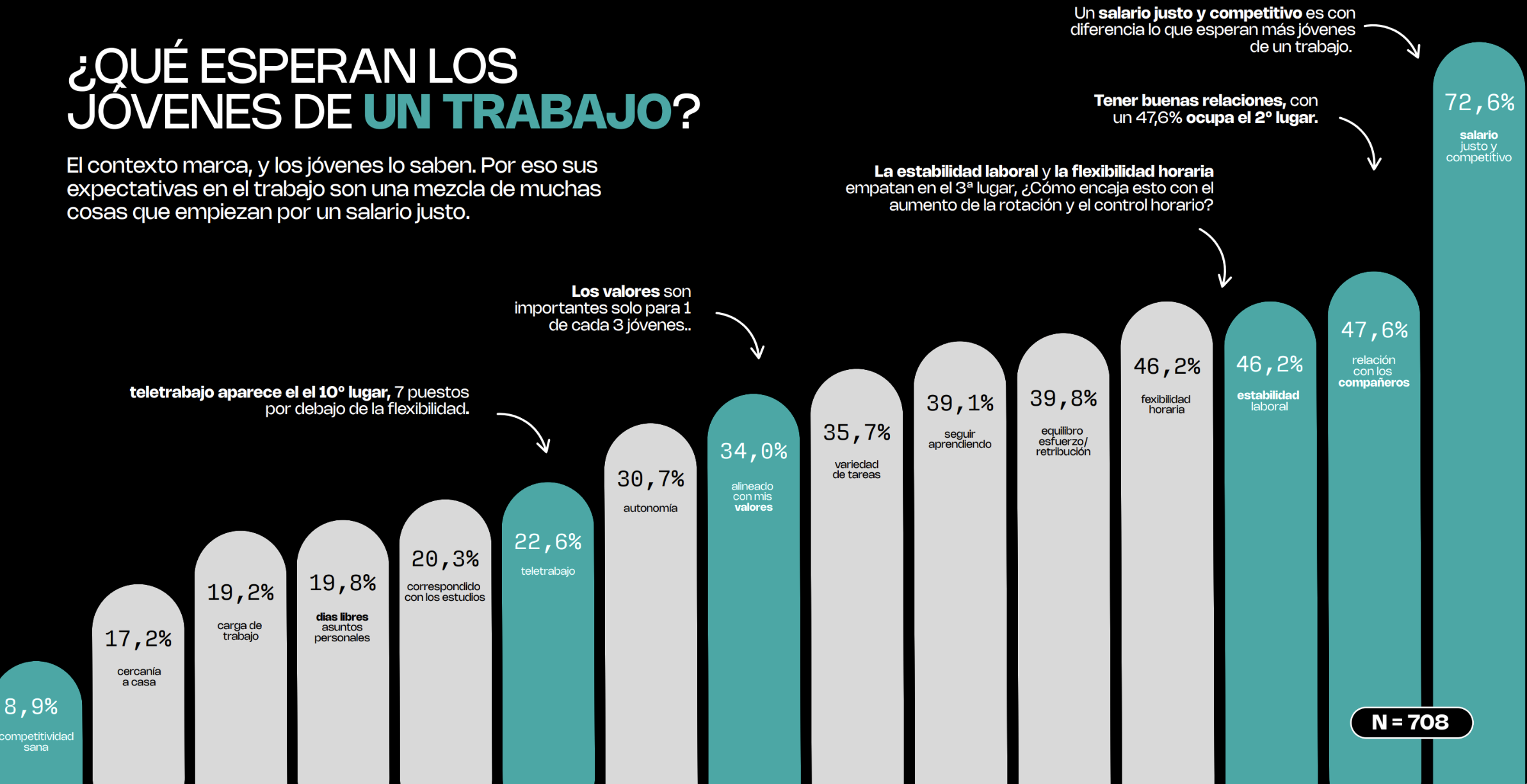
A fair and competitive salary is the main priority when choosing a job. Not as the only factor, but as a basic condition.
This reality is directly linked to data on youth emancipation. According to the report Young people leaving their home, 2024, published by Eurostat, the average age of leaving the parental home in Spain is around 30, one of the highest in Europe.
From there, other relevant elements emerge: work environment, workplace relationships, and stability, which form the core of what they consider a quality job.
Flexibility also plays a growing role, although not always in the way it is often assumed from the outside. It is not only about remote work, but about balance and sustainable working conditions.
*Data from Mazzin report: “What do young people see in their future?” – 2025
Expectations change with experience
One of the most significant findings of the report is that expectations are not static; they evolve with work experience.
In the early stages, with little or no experience, salary already appears as a key factor (70%), followed by stability (50%) and the possibility of remote work (16%).
With 1-2 years of experience, salary remains a priority (72%), while stability slightly decreases (48%) and remote work gains importance (25%).
Among young people with more than two years of experience, this trend becomes more pronounced: salary increases its importance (78%), stability loses relative weight (38%), and flexibility continues to grow (33%).
This pattern shows an important idea: as young people become more familiar with the labour market, salary becomes the central axis, while stability is no longer perceived as a guaranteed element.
Beyond the data, the report reflects a gradual process of adaptation to an uncertain labour environment.
In this context, various reports from FAD Youth and the Spanish Youth Council highlight how job precariousness, housing access difficulties, and uncertainty in the transition to employment are affecting young people’s living conditions and overall well-being.
Thus, young people do not necessarily reduce their aspirations, but rather redefine what they consider possible. However, this adaptation may involve silent trade-offs in terms of stability, autonomy, or professional development.
Not all young people experience the same future
One of the main findings of the report is that youth is not homogeneous. There are significant differences depending on:
- Socioeconomic background
- Educational level
- Place of residence
- Previous employment situation
But one factor stands out and is often left out of general analysis: social vulnerability. In these cases, the combination of precariousness, lack of networks, and barriers to access means that inequalities are not only maintained but deepened.
What does this mean for young people in vulnerable situations? From the experience of Fundación Exit, this context has very concrete implications:
- Greater difficulty accessing the first job opportunity
- Higher risk of fragmented career paths
- Less access to information, contacts, and guidance
- Greater impact of emotional distress on educational or employment continuity
In this scenario, the problem is not only “entering” the labour market, but being able to remain and progress within it. A structural issue, not a generational one.
Beyond narratives, real conditions
The data does not describe a demotivated generation; it describes a system in which:
- There is more uncertainty than stability
- More expectations of flexibility than security
- More initial access than sustainable progression
Different organisations and studies agree that youth employment conditions are not only more complex but also more unequal. And these conditions affect young people differently depending on their starting point.
The question is no longer what young people want from work. The question is what conditions we are creating as a society so that all young people, not just some, can build a stable future.
At Fundación Exit we work precisely on this point: supporting young people in situations of social vulnerability so that their first work experience is not a barrier, but a real opportunity for the future.
Because employment does not only open doors, it can also close pathways if it is not built under equal conditions.

