
Uncertainty on the rise: How young people build their future in a changing labour market
Talking about youth and employment today means talking about uncertainty. But not a homogeneous uncertainty. For some young people, the doubt lies in choosing between options. For others, especially those in contexts of social vulnerability, uncertainty starts earlier: in whether options really exist at all.
According to the latest OECD report on career readiness, 39% of students in OECD countries say they feel uncertain about their professional future at age 30. This figure not only reflects a lack of clarity, but also a more structural phenomenon: the difficulty of connecting education with an increasingly complex and unequal labour market.
In this context, the question is no longer only what do I want to be, but also what is possible to be.
Uncertainty as a symptom of an unequal system
The OECD points out that this uncertainty does not affect everyone equally. Students from more disadvantaged backgrounds:
- have less access to quality career guidance,
- participate less in career exploration activities,
- and tend to have lower educational expectations, even when their academic performance is high.
In fact, the report itself warns that socioeconomic background weighs more heavily than academic performance when defining educational aspirations. This has a key consequence: not all young people start from the same point when imagining their future.
Youth aspirations vs. employment reality
The report “Pulso Jóvenes y Talento 2025” by Mazinn shows a persistent mismatch between what young people want and what the labour market demands.
Many young people express interest in sectors such as: arts and entertainment, education, technology and media. However, employment growth projections in Spain are concentrated in sectors such as: trade and logistics, hospitality, administration, and technical and operational profiles.
The OECD has already warned about this gap: young people’s professional aspirations are concentrated in a reduced number of “highly desired” occupations, which do not correspond to the real distribution of employment.
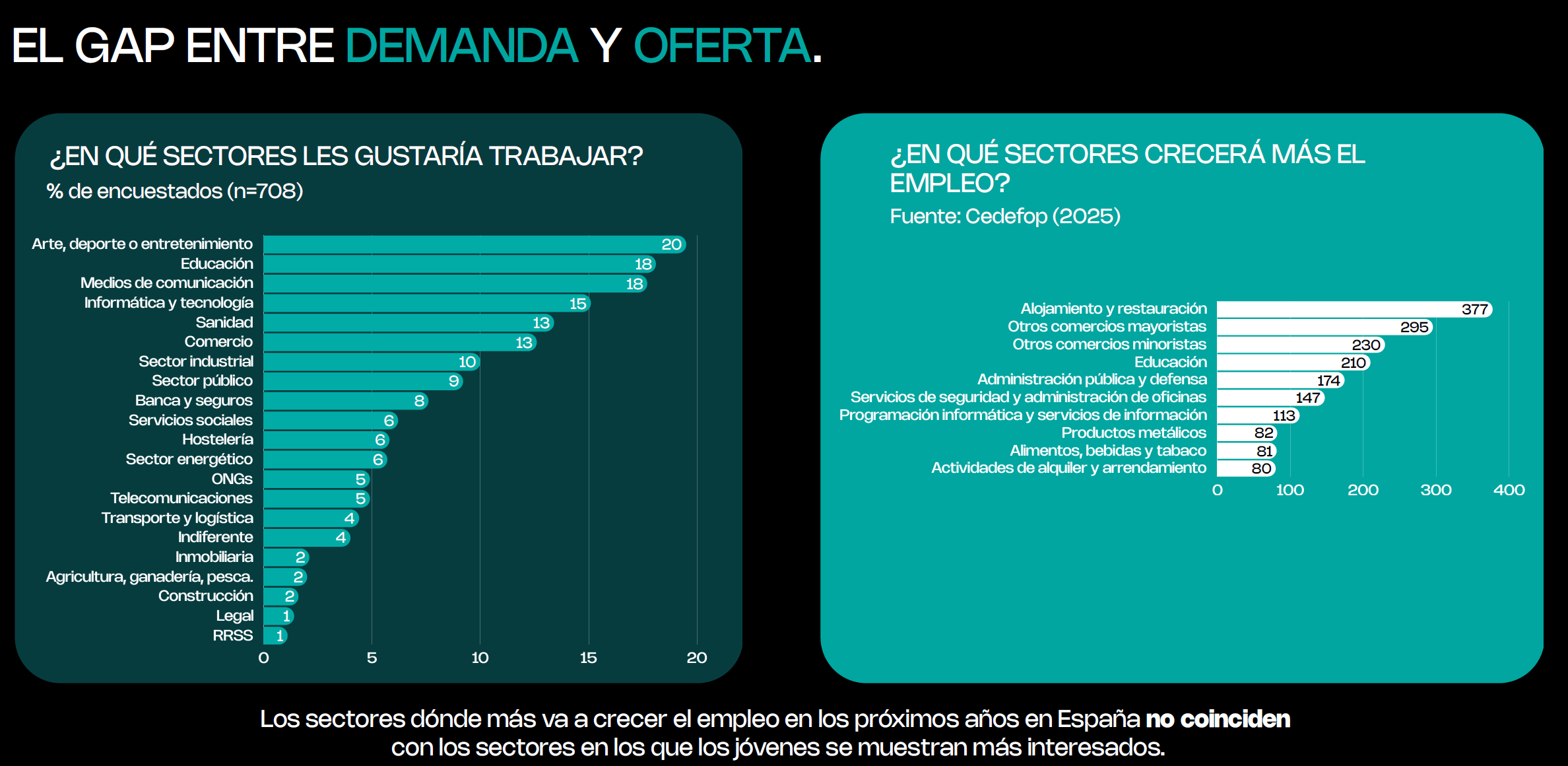
Mazinn Report – “Pulso Jóvenes y Talento 2025: Who guides their careers?”
The importance of the environment: who really guides young people
One of the most relevant findings of the study is that career guidance does not mainly depend on the education system, but on the close environment.
Parents are, by far, the ones most considered for issues related to career paths (68.8%), followed by friends (43.8%) and close relatives (28.1%). It is clear that close circles continue to be the most influential advisers.
There are gender nuances in this dynamic: while men tend to trust their friendships more, women trust their parents and close relatives more, although parents are the most important figure for both genders (70.1% for women and 67.9% for men).
Far behind are:
- 12.3% teachers,
- 6.9% ChatGPT or similar tools and social media,
- and 6.6% professional career advisers.
This pattern is especially relevant in vulnerable contexts, where social capital and information about the labour market tend to be more limited.
Work experience as a “reality filter”
In Spain we are at the bottom of Europe in many indicators related to professional development, and not only among young people.
- 35% of workers aged 20 to 64 are overqualified, meaning they have tertiary education qualifications in jobs that do not require tertiary education.
- The average age of leaving home is 30.
- And the youth unemployment rate stands at 25%.
In relation to work experience, we are also among those who take the longest to acquire it even with tertiary education.
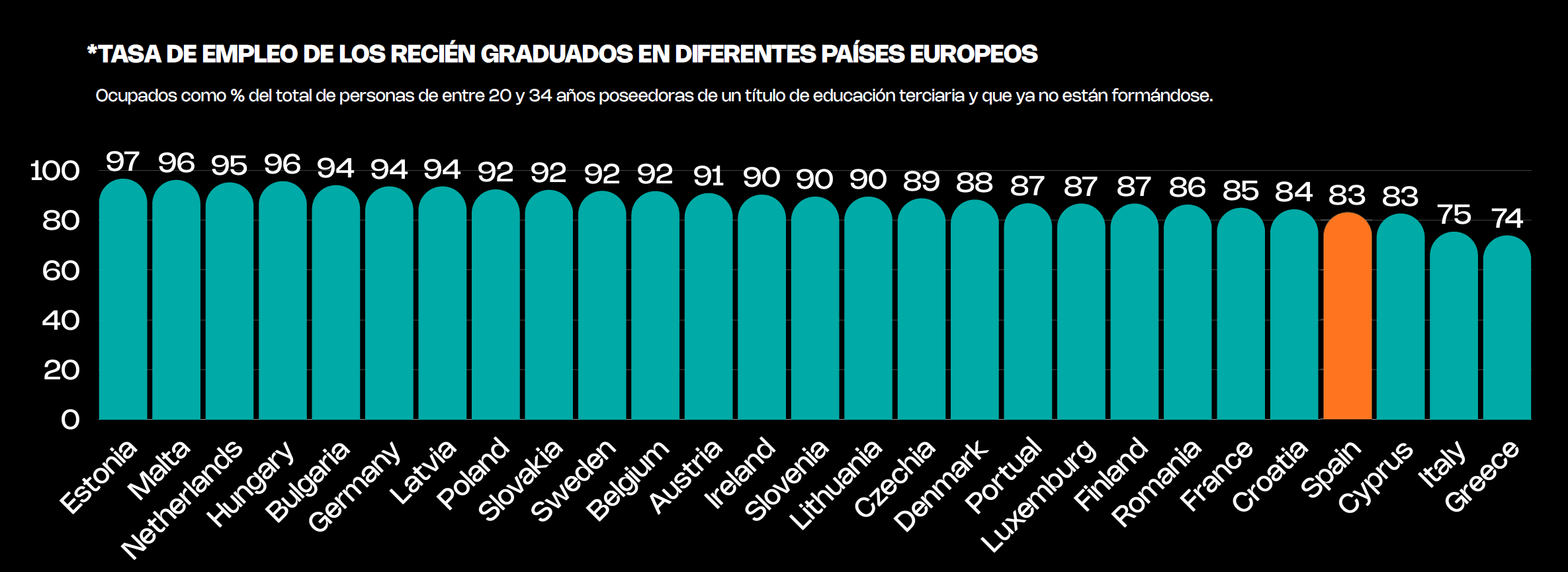
Mazinn Report – “Pulso Jóvenes y Talento 2025: How does work experience influence?” – Employment rate of recent graduates in different European countries
This report identifies a key phenomenon: experience profoundly changes the way young people interpret work.
Three stages are observed:
No experience: the idealised vision
Work is imagined as a linear growth trajectory, based on expectations and external references. Networks and the educational model strongly influence this, but they do not really know how the dynamics work.
First work contact: reality emerges
Between 1 and 2 years of experience, the first adjustments appear:
- the real dynamics of companies are understood,
- salary expectations are adjusted,
- the importance of stability is understood.
Consolidated experience: pragmatic realism
With more than 2 years of experience:
- focus on salary and conditions increases,
- the value of daily wellbeing grows,
- the perception of long-term stability decreases.
The OECD also underlines that many young people do not receive enough direct contact with the world of work, which makes informed decision-making difficult.
Experience acts as a “reality filter” that adjusts expectations, but it can also reduce the feeling of future security.
So, what do young people expect from employment, from companies and from their managers? The data show that these expectations clearly evolve with work experience.
As young people accumulate experience, they give more importance to salary and remote work, while perceiving job stability as something increasingly difficult to achieve. At the same time, the idea of security and stability within the company loses weight, as does the relevance given to diversity and inclusion. In contrast, a good work environment gains prominence and becomes an increasingly valued factor.
In relation to leadership teams, significant changes are also observed: with more experience, the need for constant supervision or receiving corrections decreases, while appreciation for respect for work-life balance increases. Meanwhile, the group of young people “newly landed” in the labour market especially values their managers being close and accessible.
What young people see as worse and what they see as better about their future
This same report shows that the perception of the future changes with work experience. As young people move forward in the labour market, concern increases regarding structural aspects such as retirement age, employment stability or social protection. The feeling also grows that their purchasing power, mental health and general wellbeing will be worse than those of previous generations.
However, this more pessimistic vision coexists with another more positive one. Young people tend to think that their future can improve in aspects that are closer and more controllable, such as working conditions, employment opportunities or work-life balance.
Overall, a dual perspective is reinforced: more critical of the system, but more optimistic regarding individual work experience.
Vocational education and training and inequality of perception
The report also focuses on Vocational Education and Training (VET), a key element for labour market insertion.
Although VET has high levels of employability in many sectors, social prejudices persist. 77% of families recognise that prejudices towards VET exist, but only a minority admit to having them personally.
This contradiction shows how educational decisions continue to be influenced by social perceptions more than by objective information.
The OECD also warns that young people with greater uncertainty tend to have worse labour outcomes in the future, even when controlling factors such as educational level or social context.
At Fundación Exit we work precisely at that point where inequalities become visible: the transition between education and employment.
This report reinforces a key idea: uncertainty is not only an individual issue, but the result of accumulated inequalities in access to information, guidance and opportunities.
When a young person does not have close professional references, when they do not access early work experiences or when their environment does not have updated information about the labour market, their decision-making capacity becomes conditioned.
That is why accompanying is not only guiding. It is opening doors that, otherwise, would not be visible.
Youth uncertainty is not a homogeneous or neutral phenomenon. It is the reflection of a system where:
- social background continues to influence aspirations,
- career guidance depends too much on the close environment,
- and work experience continues to be an unequal privilege.
The challenge is not to eliminate uncertainty, but to reduce inequality in how it is lived and faced. Because the future should not depend on who you have close to you, but on the opportunities you have ahead of you.

